


From the "PIGS" to Europe's Economic Engine
Fifteen years ago, they were the laughingstock of all Europe.
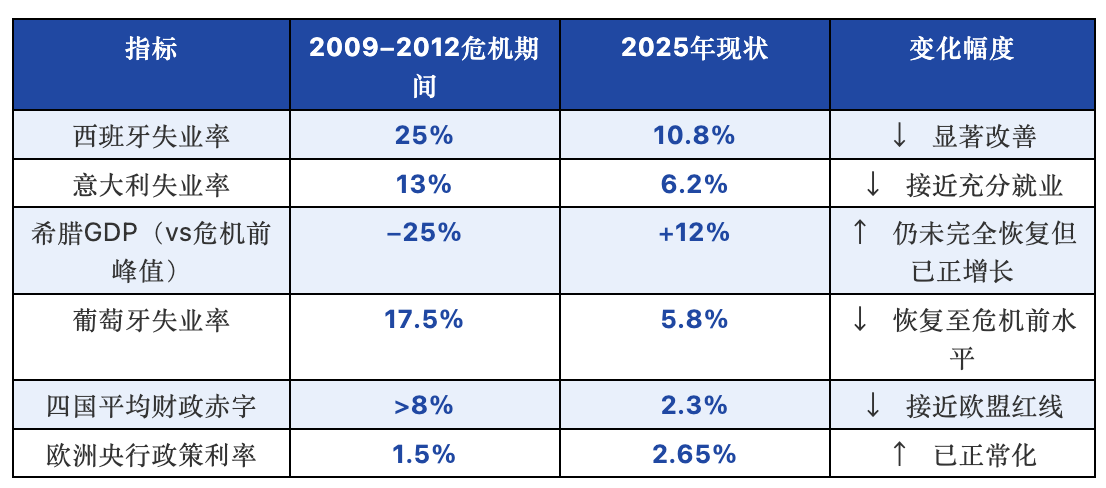
In 2009, the European debt crisis erupted, and Portugal, Italy, Greece, and Spain were mockingly labeled the "PIIGS." All four nations saw budget deficits exceed 8% of GDP, nearly dragging the entire eurozone into a deep crisis. German media branded them as "indulgent, lazy, and poor at managing finances," while Nordic countries positioned themselves as saviors, prescribing harsh austerity measures.
Fifteen years ago, they were Europe's laughingstock. When the sovereign debt crisis erupted in 2009, Portugal, Italy, Greece, and Spain were derisively dubbed PIIGS — all four ran deficits exceeding 8% of GDP, pushing the eurozone to the brink of collapse. German media labeled them lazy, pleasure-seeking, and financially reckless. Northern nations posed as saviors, prescribing brutal austerity.
Fifteen years later, the situation has completely reversed.
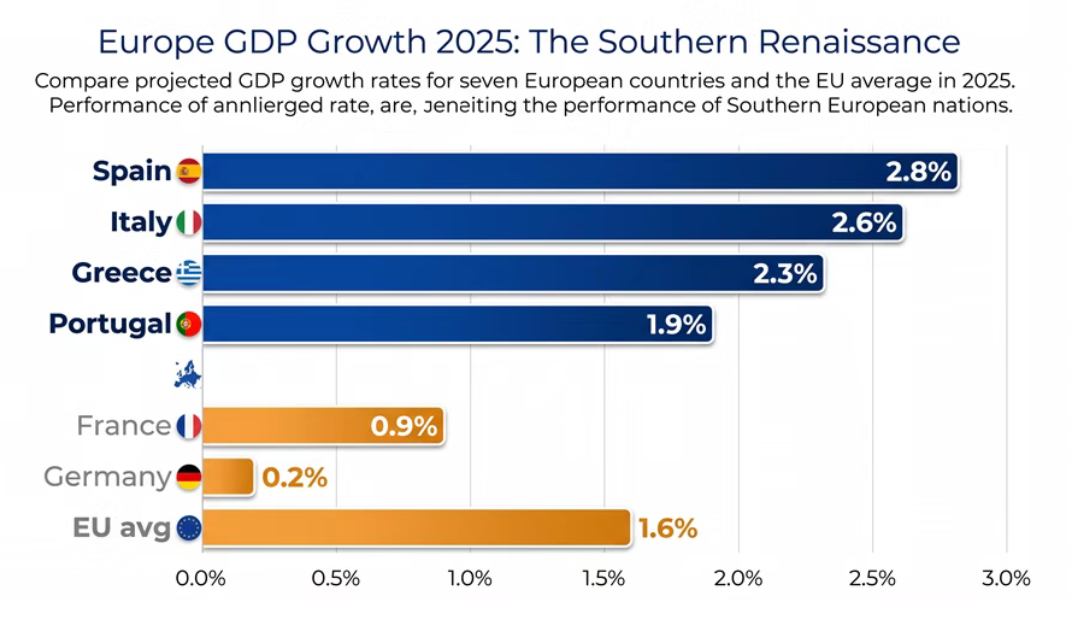
Official data from 2025:Spain leads Europe with a 2.8% GDP growth rate, followed by Italy at 2.6%, Greece at 2.3%, and Portugal at 1.9%.Traditional German industrial locomotives grew only by0.2%, France0.9%Southern European countries have significantly boosted the eurozone's average growth rate. France's L'Express put it bluntly in its headline: "La Revanche du Sud — Revenge on the North."
Fifteen years later, the reversal is stark. 2025 official data: Spain led all of Europe with2.8%GDP growth, Italy2.6%, Greece2.3%, Portugal1.9%. Germany's growth? A meager0.2%; France,0.9%Southern nations bolstered the eurozone average. French magazine L'Express ran a headline that said it all: "La Revanche du Sud — The Revenge of the North."
Deep Dive into Four Nations: What Did Each Get Right?
Spain: The Three Horsemen of Tourism, New Energy, and the Automotive Industry
Spain's economic turnaround is the culmination of long-term structural reforms:
Tourism: Tourism2025 welcomed more than9000Kvisits, a record high, contributing approximately to GDP12%。
Leading Europe's transition to new energyRenewable energy generation accounts for over 60%, surpassing Germany to become Europe's largest solar power market.
Auto Industry Unexpectedly Saved:Annual output in 2025 reached 320 million units, with new energy vehicles accounting for 35% of the total, surpassing Germany to become Europe's largest automobile producer.
Spain's resurgence is the payoff of long-term structural reform. Tourism hit a record90+ millioninternational arrivals in 2025, contributing roughly12%of GDP. Spain leads Europe in renewable energy — over60%of electricity from renewables, making it the continent's top solar installer. The auto industry was rescued:3.2 millionvehicles produced in 2025,35%EVs, surpassing Germany as Europe's largest car producer.
Powered by Spain's Digital 2030 Plan+ Significantly increase the minimum wage (monthly minimum wage1167 EUR, already exceeded Germany) + EU COVID-19 Recovery Fund (approximately1400 billion eurosPolicy support from three-pronged measures.
The policy backbone: the 'Spain Digital 2030' plan, with a minimum wage that now exceeds Germany's.€1,167/month), and EU COVID-19 recovery funds totaling approximately$140 billion.
Italy: Meloni's Economics
Italy has delivered the most surprising comeback of this cycle. When 2022 far-right leader Giorgia Meloni took office, EU markets widely feared she would undermine fiscal discipline. Yet three years later, Italy has produced a report card that left observers stunned:2025 GDP grew by 2.6%, while the fiscal deficit ratio fell from 8.9% in 2021 to 2.8%, nearing the EU's 3% threshold; public debt as a share of GDP dropped from a peak of 155% to 137.1%.
Italy is the most surprising turnaround story of the cycle. When Giorgia Meloni won in 2022, EU markets feared fiscal ruin. Three years later, the results shocked observers:2.6%GDP growth in 2025, deficit slashed from8.9%of GDP in 2021 to2.8%, approaching the EU3%ceiling; public debt fell from155%of GDP to137.1%.
Critics point out that Italy's total debt remains above €2.9 trillion, ranking among the highest globally, and its growth relies on export surpluses rather than domestic demand.But even the harshest critics must admit: under Meloni's leadership, Italy has become the least "Italian" it has been in two decades.
Critics note Italy's debt still exceeds$2.9 trillion— one of the world's largest — and growth depends on exports rather than domestic demand. But even the harshest critics concede: under Meloni, Italy is less "Italian" than it has been in two decades.
Western Greece: From "Top Eurozone Periphery" to Fiscal Role Model
Greece was the patient zero of the European debt crisis. The 2009 budget deficit exceeded15%Sovereign debt defaulted twice, received three rounds of international bailouts, and saw pension cuts.35%Public salaries were cut in half, triggering a decade of population outflow.In 2025, Greece achieved 2.3% GDP growth and reduced its deficit ratio to 2.1%, becoming one of the EU countries with the most significant fiscal improvement.Prime Minister Kyriakos Mitsotakis' approval rating hits58%a new all-time high.
Greece was the crisis patient zero. 2009 deficit over15%, two sovereign defaults, three bailouts, pensions slashed35%, wages halved, a decade of brain drain. In 2025:2.3%growth, deficit of just2.1%, among the EU's top fiscal improvers. PM Mitsotakis commands a record58%approval rating.

Turnaround relies on three pillars:
Tourism rebounds strongly: 2025 saw over 3800 million inbound tourists, surpassing the peak of 2019.
Influx of speculative capital into the real estate market (Nordic retirees investing in Greek property)
Digital administrative reform (business registration reduced from months to 24 hours).
Three pillars: full tourism recovery (38+ million arrivals in 2025, exceeding the 2019 peak), real estate capital inflows (northern European retirees purchasing Greek properties), and digital administrative reform (business registration reduced from months to 24 hours).
Portugal: A European Model of Governance Where Stability Comes First
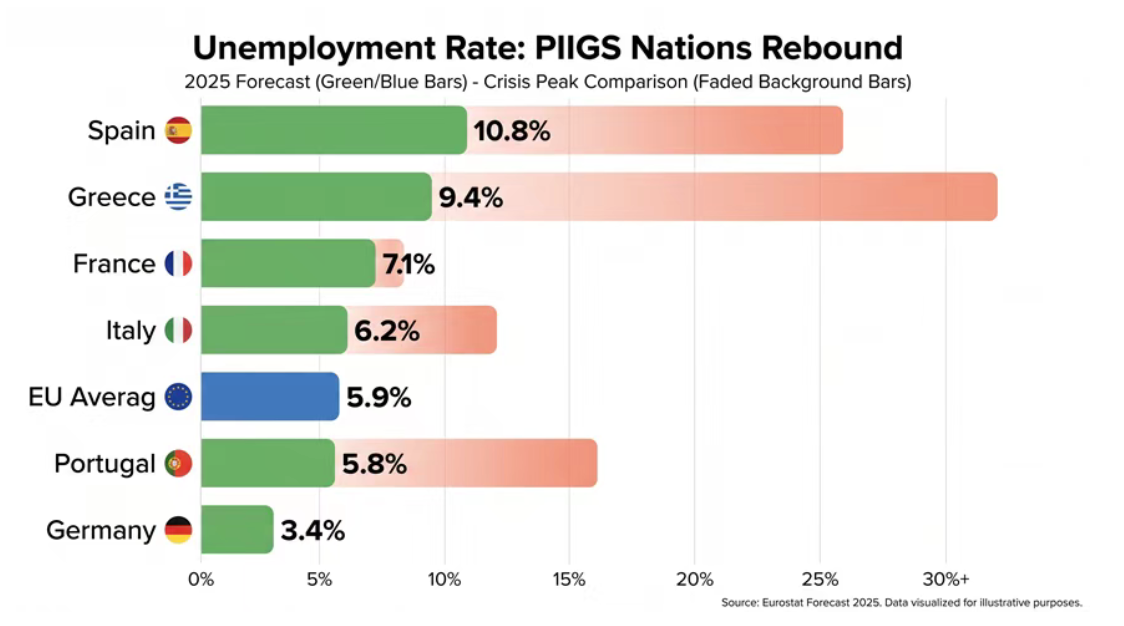
Portugal may be the most smoothly transitioning of the four countries.Strong policy continuity over the past decade: 2025 GDP growth of 1.9%, with unemployment falling from a crisis peak of 17.5% to 5.8%.The biggest achievement was completing painful fiscal consolidation without triggering large-scale social unrest, as occurred in Greece and Italy with nationwide protests.
Portugal may be the smoothest transformer of the four. With exceptional policy consistency over a decade, it grew1.9%in 2025 and unemployment fell from a crisis peak of17.5%to5.8%. Its greatest achievement: completing painful fiscal consolidation without triggering mass social unrest—something that sparked nationwide protests in Greece and Italy.
Portugal has quietly become Europe's new hub for renewable energy.—— Share of renewable energy generation in 202565%, target2030 yearsAchieve 100% power supply, attractApple, Google, MicrosoftEstablish a data center in Europe.
Portugal quietly emerged as a new European renewable energy hub —65%of electricity from renewables in 2025, targeting 100% by2030Apple, Google, and Microsoft have all built data centers in Portugal.
Deep Dive: Why the "Nordic Model" Is Failing in Europe
Behind Southern Europe's turnaround lies a deeper story: the collective slowdown of manufacturing powerhouses in Northern and Central Europe.Germany's growth in year 2025 was only 0.2% — Europe's economic engine faces a triple crisis:New energy vehicle transition disrupts the traditional automotive industryVolkswagen, BMW, Mercedes-BenzProfits plummeted; exports to China cooled amid geopolitical tensions; and the construction sector entered a recession due to high interest rates.
France is struggling with political paralysis.2024-2025: Prime Minister changed three times; nationwide strikes over Macron's pension reform; consumer confidence index plummets tofive-year low。
Behind Southern Europe's surge lies a deeper story: the collective stumble of Nordic and Central European industrial giants. Germany's 2025 growth of0.2%reflects atriple crisis: EV transition hollowing out traditional auto (Volkswagen, BMW, Mercedesprofits all tumbled sharply, cooling China exports amid geopolitical friction, while a construction sector grapples with recession in the face of high rates. France is mired in political paralysis — three prime ministers in 18 months, Macron's pension reform sparking nationwide strikes, and consumer confidence hitting a five-year low.
Low-Interest Era: The Hidden Dividend in Southern Europe
After the European debt crisis, the European Central Bank implemented a prolongedTen yearsthe ultra-low interest rates, even negative interest rate policies. For highly indebted Southern European countries, this amounts to a massive hidden subsidy—enabling refinancing at near-zero cost.astronomical figureof sovereign debt.In contrast, Germany failed to advance digitalization and industrial upgrading during the low-interest era. When interest rates normalized to 2022%, German companies suddenly faced high financing costs. Meanwhile, Chinese electric vehicles had already entered the European market, and Southern Europe was competing for investments in high-end manufacturing.
After the euro crisis, the ECB maintained near-zero and even negative rates for adecade. For high-debt Southern nations, this represented a massive hidden subsidy: refinancing astronomical sovereign debt at near-zero cost. Meanwhile, Germany failed to advance digital transformation and industrial upgrading during the low-rate era. When rates normalized after2022, German firms suddenly faced high financing costs—just as Chinese EVs entered Europe and Southern Europe began aggressively competing for high-end manufacturing investment.
Structural dividends from the EU Recovery Fund
launched by the EU in 20207500 billion eurosThe Next Generation EU recovery fund, allocated as a percentage of GDP.Southern Europe receives a significantly higher share than Northern Europe: Spain approximately €1400 billion (about 10% of GDP), Italy approximately €1900 billion (about 9%), Greece approximately €400 billion (about 20%), and Portugal approximately €160 billion (about 7%).These funds are mandated for digitalization, green transition, and structural reforms, providing the foundational capital for industrial upgrading in Southern Europe.
The EU's$750 billionThe Next Generation EU fund, launched in 2020 and distributed roughly proportional to GDP, provided Southern nations with significantly more relative to their size: Spain ~$140 billion(~10% of GDP), Italy$190 billion(~9%), Greece ~$40 billion(~20%), Portugal ~$16 billion (~7%Funds were mandated for digital transformation, green reform, and structural change—collectively forming the capital base for Southern industrial upgrading.
Demographics: The "Late-Mover Advantage" in Southern Europe
Germany is one of the countries with the most severe population aging in the world. In 2025, the proportion of people aged over 65 exceeded23%, the working-age population continues to shrink.Spain saw its workforce increase by approximately 40 million in 2025, driven by immigration and a slight rebound in birth rates.Greece faces a severe demographic crisis, with a net outflow exceeding over the past decade50K), but the remaining young people have largely moved into technology and service sectors, driving productivity gains.
Germany has one of the world's most severe aging populations — those over 65 exceed23%in 2025, with the working-age population shrinking continuously. Spain, by contrast, saw its labor force grow by ~400,000in 2025, thanks to immigration and a modest rebound in birth rates, Greece still faces a severe demographic crisis (net outflow exceeding500,000over a decade), but the young people who stayed moved into tech and services, driving productivity gains.
Foreign Media Reactions
🇩🇪Germany's Der Spiegel:The South is outperforming the North. Spain's 2.8% growth versus Germany's 0.2% isn't a blip — it's the structural result of a decade of European monetary policy that rewarded the wrong behaviors.
🇬🇧The Financial Times (UK):Giorgia Meloni has implemented Italy's most disciplined fiscal policy in 30 years. She understood that European institutions would tolerate almost anything except breaking the euro rules. She played a blinder.
🇫🇷France's L'Express:The South's Comeback — For the first time since the euro was introduced, Southern Europe is driving European growth while Germany stagnates. The EU's economic geography has fundamentally shifted.
🇺🇸U.S. Foreign Policy:Southern Europe's renaissance is also a political story. Populist governments in Rome and Athens have found that fiscal discipline and sovereignty protection are not contradictory — they can coexist.
🇬🇷Greece's "Kathimerini":We were the weakest link; now we are proof that every crisis contains the seeds of its own correction. Greece's journey from a bailout pariah to a fiscal model is not a miracle—it is the result of painful, unglamorous reforms.
Data Dashboard: Key Economic Indicators for Major European Countries in 2025
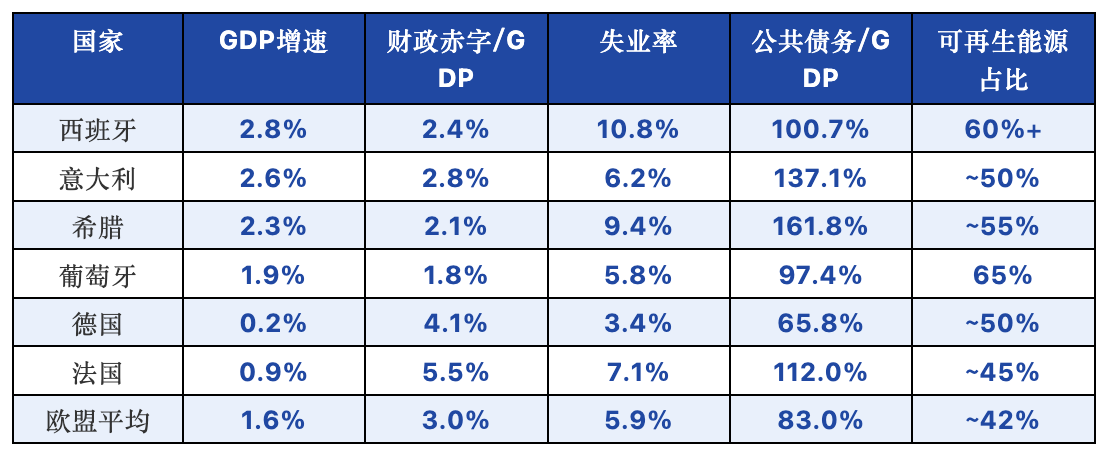
Eurozone Debt Crisis vs. 2025: Four Nations' Key Data Reversal
Expert Review
🏅Olivier Blanchard
Former Chief Economist of the IMF / Senior Fellow at the Peterson Institute for International Economics
The rebound in Southern Europe highlights a lesson often overlooked by Northern Europeans: fiscal discipline is necessary within a monetary union, but it's not enough. True competitiveness comes from investment—and investment requires confidence and predictability. The most important thing the EU Recovery Fund did wasn't the money itself; it sent a clear signal to Southern Europe that reforms are being taken seriously, unlocking private capital follow-through.
Southern Europe's recovery highlights a lesson the Nordic bloc overlooked: in a currency union, fiscal discipline is necessary but not sufficient. True competitiveness stems from investment—and investment requires confidence and predictability. The EU Recovery Fund's greatest impact wasn't the funding itself, but its signal that "we are serious about reform," which unlocked follow-on private capital.
🏅Herman Perle
Director of the European Economy Program at the Mercator Institute for China Studies, Berlin
Germany is at the center of a "perfect storm": its auto industry is struggling to transform amid pressure from Tesla and Chinese EVs, construction has collapsed due to high interest rates, and exports to China have cooled because of geopolitical tensions. This isn't a cyclical downturn—it's structural stagnation. Berlin must make painful choices: either accept the fate of becoming "Europe's Japan" or launch a large-scale industrial policy transformation akin to that after German reunification.
Germany is caught in a "perfect storm": its auto industry is squeezed between Tesla and Chinese EVs, construction is collapsing under high interest rates, and exports to China are cooling amid geopolitical tensions. This isn't cyclical—it's a structural stall. Berlin faces a painful choice: accept becoming Europe's "Japan," or launch a massive industrial policy shift on the scale of post-reunification Germany.
🏅Maria Demertzis
Deputy Director, Centre for European Policy Studies (CEPS)
Meloni offers a crucial policy experiment: Do right-wing leaders necessarily undermine fiscal discipline? The answer is no—at least in her case. She skillfully leveraged the EU's post-Ukraine war tolerance for fiscal expansion, cutting the debt-to-GDP ratio while expanding industrial subsidies. This is pragmatic Italian-style governance.
Meloni's Italy presents a key policy test: does far-right rule inevitably undermine fiscal discipline? The answer is no—at least in her case. She skillfully leveraged the EU's post-Ukraine openness to fiscal expansion, lowering the debt-to-GDP ratio while boosting industrial subsidies. This reflects a distinctly Italian brand of pragmatism.
Final Thoughts
The resurgence in Southern Europe is neither accidental nor a simple cyclical rebound.
It reveals a structural shift in Europe's economic landscape: while manufacturing powerhouses have slowed due to the pain of industrial transformation, Southern European economies driven by tourism, energy transition, and digital reforms are finding their own rhythm. The austerity measures imposed during the Eurozone crisis were not entirely wrong, but they obscured a deeper issue.— EuropeCurrency UnionFrom its inception, the eurozone has been plagued by a North-South divide: the low efficiency of Southern Europe and the high savings rate of Northern Europe create inherent tensions within a single-currency framework.
Southern Europe's resurgence is neither accidental nor a simple cyclical rebound. It reveals astructural shiftin Europe's economic geography: as industrial powerhouses stumble through painful transitions, Southern economies driven by tourism, energy transition, and digital reform are finding their rhythm. The 'austerity prescription' of theEurozone crisisThe years weren't entirely wrong—but they obscured a deeper issue: the eurozone was built with structural North-South tensions in its DNA. Under a shared currency, Southern inefficiency against Northern savings was destined to create persistent friction.
Can this turnaround be sustained?
Spain's property boom, Italy's high debt, Greece's population drain, and Portugal's economic narrowness—these are all looming over Southern Europe.The Sword of Damocles。But at least on this day in 2026, Southern European nations are proving that no country in Europe is destined to remain permanently behind, and no economic model can lead forever.This "The South's Revenge", perhaps it has only just begun.
The question now is: can this resurgence last? Spain's real estate bubble, Italy's high debt, Greece's demographic drain, Portugal's industrial concentration — these are allSword of Damocleshanging over Southern Europe. But at least in 2026, Southern nations are proving a broader truth: in Europe, no country is destined to lag forever, and no economic model lasts indefinitely. This 'Southern Revengemay be just beginning.
© 2026 Bilingual China-UK Observatory | Data Sources: Eurostat, European Commission, IMF, OECD, and official data from national central banks